In the demanding realm of today's pro-level oversteer competition, success is not merely solely a product of sheer horsepower or pilot aggression. Instead, it has evolved into a multifaceted science which necessitates a meticulous marriage of picking a proven vehicle platform, outfitting it with the correct performance parts, and, most essentially, understanding its real-time performance on the course through advanced vehicle dynamics analysis tools. This definitive guide will serve as your blueprint starting from the very first idea of a drift build all the way to the final telemetry-optimized refinements that turn a powerful machine into a predictable podium finisher. We will examine in detail the methodical process of car suspension tuning, illustrating how a state-of-the-art vehicle dynamics tool like precise measurement hardware eradicates approximation and provides unparalleled insight into your vehicle's true performance.
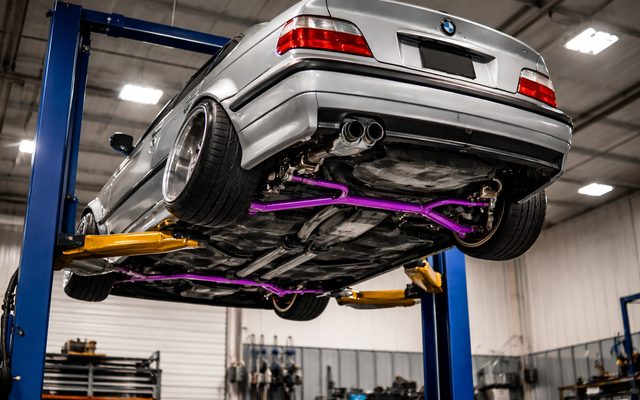
The foundation of any great drift car is, undoubtedly, the platform itself. A select group of cars have earned iconic reputation within the worldwide sliding scene due to their inherent balance, robust construction, and the vast availability of specialist components available. Picking the correct car is the first and most crucial decision a driver will make. To illustrate, the the E36 generation BMW is commonly accepted as among the finest all-around drift cars of the modern era. Its excellent balanced front-to-rear weight, combined with a rear-wheel-drive layout and robust straight-six engines, creates a car that is simultaneously accessible for beginners and incredibly competitive in the hands of a expert pilot. The successor of this lineage, the BMW E46 platform, improves on these strengths with a even more developed structure, wider stance for improved stability, and yet a greater degree of steering angle as standard from the factory. A distinct powerful contender in the top-level circuit is the Corvette C6.
This V8-powered sports car offers a unique combination of benefits to the sideways discipline, including a light aluminum frame, a rear-mounted transaxle that aids in an excellent front-to-rear mass ratio, and the immense thrust of a large-displacement LS V8 motor. This combination renders it an absolute monster on track, designed of initiating and sustaining long slides with seemingly easy deployment of throttle. For those seeking outstanding bang-for-the-buck, the Nissan Z33 excels as a excellent candidate. It arrives from the factory with a rigid body structure, a effective OEM locking differential, and the responsive V6 motor that delivers plenty of performance for practicing and moving up in the discipline. Its follow-up, the Nissan Z34, brings more advancements in body strength, steering geometry, and outright powerplant performance, establishing its status as a popular selection among competitive drivers. Additional iconic cars that merit mention include the lightweight unique Mazda FC, the most popular Nissan S13, the V8-powered SN95 generation Mustang, the modern BMW E90, and the small yet unbelievably playful and instructive MX-5 Miata. Each of these chassis gives a distinct set of characteristics, complexities, and possibilities, but they all have in common the fundamental ingredients essential to serve as a capable drift machine.
However, selecting the optimal car is merely the beginning. To access the full potential of every of these cars, significant changes to the steering system and damping and springing systems are absolutely essential. This is where the realm of precision tuning hardware enters critical view. The one most game-changing modification for a dedicated drift machine is the installation of a maximum-angle steering angle kit. These advanced kits, for example those engineered by specialist companies like SLR Speed, are designed to radically expand the car's available turning lock. A standard road car is extremely limited in how far its front wheels can turn, a design compromise for daily operation. In drifting, but, extreme opposite lock is frequently required to catch and hold a drift. An modification kit exchanges the factory steering knuckles, rod ends, and often A-arms with pieces that allow the wheels to achieve degrees of turn beyond 70 or even 80 °, as opposed to a typical factory setting of around 40 to 50 degrees.
This immensely expanded lock gives the operator with significantly more command during a slide, allowing it to be much simpler to start a drift, maintain it through a extended turn, and switch seamlessly from one angle to the other. The contrast in controllability is absolutely transformative. Coupled with a correctly chosen steering kit is the just as critical enhancement to the vehicle's suspension. Store-bought or even premium sport coilovers are simply not engineered for the specific and extreme needs of competitive oversteer. A dedicated set of coilovers is paramount. These specific dampers incorporate specific piston tuning and spring strength that are designed for the extreme mass transition that is typical of aggressive driving. When a operator begins a slide, the chassis's mass is thrown rapidly to the front of the bend. Proper drift-spec dampers manage this transfer in a consistent fashion, permitting the chassis to settle rapidly and providing the operator accurate response through the steering wheel and seat. They additionally enable accurate setting of stance, damping stiffness, and corner weighting, which are all key aspects of dialing in the car's handling to a particular venue or driving technique. As a system, a high-quality drift angle kit and a properly selected pair of drift-spec adjustable dampers are the absolute physical base upon which all future tuning is built.
Once the fundamental parts is installed, the subsequent critical stage in the development is the meticulous tuning of the vehicle's wheel angles. This is the realm of vehicle alignment optimization, a methodology that can feel daunting to the uninitiated but is, in fact, the defining factor to turning a collection of fast parts into a unified and consistent machine. The most discussed aspect of alignment for sliding is undoubtedly camber. Camber is the tilt of the wheel compared to the vertical axis when looked at from the forward of the vehicle. If the top of the wheel is leaning towards the car, this is known as camber-in. In oversteer driving, negative camber on the front axle wheels is universally used and is considered necessary. The reason is deeply linked to physics.
When a vehicle is turning at extreme angles, the frame rolls toward the outer of the bend. This chassis roll causes the outer front wheel to reduce its ideal footprint with the tarmac. By applying inward lean, the tire is pre-tilted to counteract this lean. As the car rolls into the corner, the outside front tire gains a better contact patch on the car alignment tuning road surface, increasing its grip at the critical moment when it is needed most for directional command. Typically, front adjustments for a competition drift machine vary from approximately -3 degrees to as much as -5 degrees or even beyond, based on the specifics of the car setup, compound selection, and operator style. The back wheels also utilize negative camber, but the angles are typically more modest and subtler than the front. Excessive negative camber at the back can make the car overly loose and hard to control on power application, as it diminishes the usable tire footprint of the driving tires during straight-line power delivery. Hence, rear axle angles are frequently in the vicinity of -1 degree to -3 degrees, striking a precise balance between giving enough side bite to assist in entering and sustaining the angle while also keeping usable grip for exiting the corner. Camber is just one component of the more complex suspension geometry puzzle, which also encompasses toe setting, caster, and steer correction adjustment.
Toe setting refers to the angle of the wheels as seen from the top. Positive toe means the leading edges of the tires are nearer together than the rear edges, while outward toe means the converse. For oversteer, a modest amount of front axle negative toe is commonly used to sharpen the initial steering response, making the car feel more agile and eager to initiate a slide. Rear toe is typically set to zero or a very minute amount of positive toe to foster straight-line stability under throttle. self-centering is the longitudinal or aft inclination of the kingpin axis when looked at from the side-on of the car. Positive caster increases steering feel and high-speed stability, and it furthermore adds to camber increase during turning, which is highly beneficial. Adjusting these values is a intricate interaction where a adjustment to one value can and often will impact the other settings. The traditional process for setting a vehicle's alignment for drifting has historically been a time-consuming affair of guesswork and adjustment. A driver or engineering group would introduce a adjustment based on experience, run the vehicle on track, rely on the operator's individual perception and comments, and then make an additional change. This cycle would iterate again and again until the car felt "acceptable" or the allotted track period was exhausted. This methodology is not just incredibly wasteful in terms of hours and resources, but it is furthermore inherently flawed.
Driver feel is a famously unreliable measurement tool, affected by numerous factors such as fatigue, evolving track surfaces, temperature, and simply the focus of the pilot on that particular run. What feels "tail-happy" on one pass might feel "understeery" on the next pass, resulting in confusing data and ineffective adjustments. This traditional problem in vehicle dynamics optimization is precisely where state-of-the-art engineering tools has stepped in to transform the methodology.
The development and adoption of advanced suspension tuning applications has brought about a new paradigm for engineering and perfecting professional drift machines. These platforms, showcased by groundbreaking products like GripDial, work by physically measuring the actual mechanical movement of the vehicle as it is piloted on the circuit. Unlike using personal feel, these devices collect objective metrics on critical parameters such as damper compression and extension, individual tire rotation, lateral and longitudinal g-forces, lock position, and driver input position. This suspension tuning tool acquired information flow is then processed by drift angle kits sophisticated software that can plot and analyze the information in a actionable way. For the first time, drivers and crews can observe precisely what the car is doing at each moment of a lap. This ability revolutionizes the whole chassis setup procedure. Imagine the specific goal of dialing in the front axle negative camber for a specific vehicle. Instead of applying a change from -3 degrees to -3.5 degrees and then testing many laps to try and "sense" a improvement, a suspension tuning tool can give immediate and clear information. The software can show visually how the suspension's grip is performing during the most important stages of a angle: the initial flick, holding the angle, and transition. It can demonstrate if the current angle is permitting the steering tire to keep ideal loading or if the compound is working inefficiently on its external shoulder.
The software can after analysis suggest data-driven recommendations for adjustment. Perhaps the telemetry reveals that the outside front tire is even stressing its outer shoulder at -3.5 degrees of camber, implying that a move towards negative camber, say -4 degrees, might be advantageous. Alternatively, the information might reveal that the tire is failing to reaching optimal operating temp or that the inner shoulder is wearing excessively, which could suggest that there is overly aggressive angle and a slight decrease back to -3.2 degrees would be better ideal. This degree of accuracy and actionable analysis was completely unattainable in the era of exclusively seat-of-the-pants adjustment.
The impact of employing a advanced suspension tuning tool extends much further than only optimizing alignment. It becomes an essential damper adjustment manual that is specific to your exact chassis. When fine-tuning the damping values on your coilovers, rather than relying on general advice or replicating another driver's settings, you can use the data to see how the car is behaving in relation to your adjustments. The tool can graph the damper movement data over a lap, revealing if the coilovers are controlling the chassis motion effectively or if they are causing the vehicle to oscillate uncontrollably after a direction change. It can aid in identifying challenges like excessive compression or topping out, enabling you to make data-backed adjustments to spring preload, damping settings, or stance. This process applies equally to the complex process of corner balancing. In addition to camber angle, the system can offer analysis into how adjustments to toe and caster are influencing the vehicle's balance during specific phases of a lap. For instance, it can assist you to find the optimal amount of front toe-out for your particular angle kit setup and piloting style by showing the speed of turn-in reaction and the consistency of the chassis at lock steering angle. This makes the system an exceptionally effective performance optimization handbook that is actively informed by the live behavior of your personal car on the circuit. It elevates the whole endeavor from a mysterious craft into a methodical engineering exercise.
Additionally, the utility of a platform like modern telemetry is not restricted to experienced teams with extensive budgets. For the amateur enthusiast, it serves as an powerful force multiplier. It practically offers the builder with the analysis of a full-time dynamics engineer without needing the associated cost. It accelerates the learning curve by delivering definitive solutions to problems that would traditionally take seasons of experience to understand. A tuner can see how their individual car reacts to various inputs, building a more intuitive comprehension of car control in the journey. It furthermore makes accessible advanced suspension engineering concepts, enabling anyone with the ambition to perfect their vehicle to do so in a efficient and productive manner. This is notably valuable in a sport like oversteer competition, where tuning knowledge has in the past been a tightly held commodity among professional drivers. Now, that power can be in the garage of every dedicated enthusiast.
In the final analysis, the path to engineering and tuning the ideal championship-contending drift machine is a multi-stage endeavor that seamlessly combines time-honored mechanical knowledge with revolutionary digital solutions. It starts with the strategic pick of a capable car, then built upon the installation of non-negotiable drift-spec components like drift-spec steering angle kits and properly selected competition suspension units. The journey then advances into the intricate realm of chassis dynamics adjustment, where settings like camber, toe setting, and caster are carefully adjusted to complement the vehicle's modified capabilities and the pilot's specific technique. Finally, and what truly differentiates the contemporary process from the old ways, is the integration of a powerful vehicle dynamics tool. This tool removes the guesswork and inefficiency of solely subjective adjustment by providing empirical, real-time information on how the vehicle is really performing. It functions as an incredible engineering partner, a comprehensive drift suspension tuning guide, and a comprehensive vehicle dynamics tool. In unison, this holistic approach leads to that every component of the drift car—from the choice of the car to the final adjustment on the suspension—is refined for ultimate performance on the circuit. It embodies the full maturation of the art of drifting, merging mechanical driving skill with surgical vehicle setup to create the most competitive vehicles attainable.